HTTP is stateless: every request arrives on its own, and nothing in it says the client has been here before. A session is how a server remembers a client between requests. The server gives the client an unguessable id in a cookie, the client sends it back with every request, and the server finds the state it kept under that id. This chapter covers the session API, the cookie, where sessions are stored, and session-scoped beans.
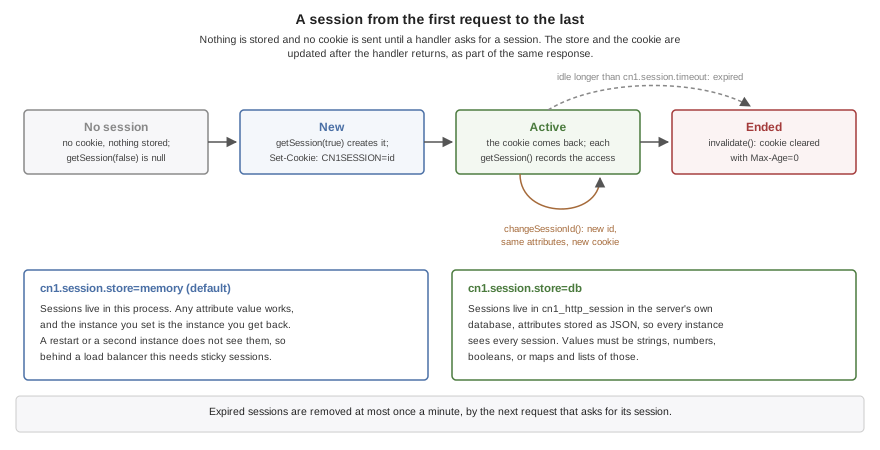
Starting a session at sign-in
A handler reaches the session through the request:
@RestController
public class Login {
    @PostMapping("/login")
    public String login(HttpServer.Request request, @RequestParam("user") String user) {
        // ... check the credentials ...
        HttpSession session = request.getSession(true);
        session.changeSessionId();        // never keep an id from before the login
        session.setAttribute("user", user);
        return "ok";
    }
}
getSession(true) returns the client’s session, creating one if the request
carried no valid cookie. Nothing is stored and no cookie is sent until something
calls it, so a server that never uses sessions — an API authenticated with
bearer tokens, say — pays nothing for them and sets no cookie. The server the
build generates stores each session and sends its cookie when the request ends.
The call to changeSessionId() isn’t optional at sign-in. It gives the session a
new id, keeps its attributes, and sends the client the new cookie. Without it a
session id the client held before signing in stays valid after, and an attacker
who planted that id in the victim’s browser beforehand — a session fixation
attack — is signed in along with the victim.
Reading and ending a session
Most requests want the session only if there is one:
@GetMapping("/me")
public String me(HttpServer.Request request) {
    HttpSession session = request.getSession(false);   // never creates one
    Object user = session == null ? null : session.getAttribute("user");
    return user == null ? "nobody" : String.valueOf(user);
}
getSession(false) never creates a session, and answers null for a client
without a valid one, so a read-only request doesn’t create a session as a side
effect. invalidate() ends one, and the response clears the client’s cookie:
@PostMapping("/logout")
public String logout(HttpServer.Request request) {
    HttpSession session = request.getSession(false);
    if (session != null) {
        session.invalidate();          // the response clears the cookie
    }
    return "bye";
}
After invalidate(), the request no longer has that session: getSession(false)
returns null, and getSession(true) starts a new one, whose cookie the response
sends after clearing the old one.
HttpSession method | What it does |
|---|---|
| Read, set and remove the session’s state. Setting |
| A copy of the attribute names. |
| A new id for the same session, with a new cookie. Call it at sign-in. |
| End the session, and ask whether it has been ended. Reading or writing an
attribute of an ended session throws |
| Whether the current request created the session. |
| How long the session may go unused before it expires, for this session alone. |
| When it was created and last used, in milliseconds since the epoch. |
| The id the cookie carries. It’s a credential, so never log it. |
A session is saved after the handler returns, and only when the request changed it. A request that only reads its session writes nothing, apart from the last access time the database store keeps. That store updates it when it’s older than a minute, or a quarter of the session’s timeout when that’s shorter, and allows the same interval on top of the timeout before it calls a session expired, so a session in use is never expired early.
With the database store, two requests of one client load separate copies of the session. If one of them invalidates it, the other can’t write it back: a copy of a session whose row is gone is dropped rather than saved again, so a request still running with an old cookie can’t undo a sign-out.
The cookie
The session id is 192 bits from a cryptographically secure random source,
encoded for a cookie. The cookie is sent with Path=/ and HttpOnly, so
scripts in a page can’t read it. SameSite=Lax keeps a browser from sending it
with a form another site posts. On a TLS server it’s also Secure, so a browser
never sends it over plain HTTP. It carries no Max-Age, so it lasts until the
browser closes; how long the session lasts is the server’s decision.
| Key | What it sets |
|---|---|
| The cookie’s name, |
| Seconds a session may go unused before it expires, 1800 by default. Zero means sessions never expire, and a negative value stops the server at start-up. |
|
|
|
|
|
|
@SessionConfig sets the same keys in source — @SessionConfig(store = "db",
timeoutSeconds = 3600) — as the bottom layer under the properties files, and
refuses at build time a value this table says would stop the server; see
Settings in source.
An injected Backend returns the server’s sessions from getSessions(), whose
getStore() answers the store in use.
Where sessions are kept
cn1.session.store=memory keeps sessions in the server’s own memory. It needs
nothing, any object can be an attribute, and the object a request sets is the
object the next one gets. It also means sessions end with the process, and that a
second instance of the server doesn’t know about them, so behind a load balancer
it needs the balancer to send each client to the same instance.
cn1.session.store=db keeps sessions in the server’s own database, in a table
called cn1_http_session that the server creates on first use. Every instance of
the server then sees every session, a restart loses nothing, and a deployment can
add or replace instances at will. The price is in what an attribute can be: the
attributes are stored as JSON, so a value must be a string, a number, a boolean, or
a map or list of those. Anything else is written as JSON can write it and read back
as whatever JSON reads, which isn’t the object that was stored.
Each row belongs to a namespace, and a server only reads the rows of its own.
By default the namespace is empty, so every server that uses the database shares
its sessions, as Spring Session’s JDBC store does. Browsers don’t keep cookies
apart by port, so two different servers on one host that share a database would
each accept the session cookie the browser sends to both, including a signed-in
user’s. Give each project its own cn1.session.namespace to keep them apart;
every instance of one project keeps the same one, so they still share sessions.
Either way, an expired session is removed at most once a minute, by the next request that asks for a session, and a request that presents an expired session’s cookie is treated as having no session at all.
Session-scoped beans
A bean marked @SessionScope exists once per session, which suits state that
belongs to a client and has behaviour of its own:
@Component
@SessionScope
public class Cart {
    private final List<String> items = new ArrayList<String>();

    public synchronized int add(String sku) {
        items.add(sku);
        return items.size();
    }

    public synchronized List<String> items() {
        return new ArrayList<String>(items);
    }
}
A singleton that injects it receives a generated stand-in, and each call on the stand-in reaches the calling client’s own instance:
@RestController
public class CartApi {
    private final Cart cart;        // a stand-in: each call reaches the caller's own cart

    public CartApi(Cart cart) {
        this.cart = cart;
    }

    @PostMapping("/cart")
    public String add(@RequestParam("sku") String sku) {
        return String.valueOf(cart.add(sku));
    }

    @GetMapping("/cart")
    public List<String> list() {
        return cart.items();
    }
}
Using the stand-in starts a session if the client has none, as getSession(true)
would. The instance is built on the session’s first use and kept by the server in
memory for as long as the session lives. It’s never written to the session store,
whichever store is configured, so with cn1.session.store=db each instance of
the server builds its own copy for a client it serves. State that has to follow the
client from one instance to another belongs in the session’s attributes instead.
The bean’s @PreDestroy method, or its destroyMethod for a @Bean method, runs
when the session ends. That’s at the end of the request that invalidated it, when
the periodic purge finds it expired, or when the server stops.
Two requests from the same client can run at once — two browser tabs, or an app
that doesn’t wait for one answer before sending the next — and they reach the same
instance. The methods of a session-scoped bean therefore need to be safe to call
concurrently, which is why the Cart above synchronizes them.
A session-scoped bean can’t inject the request or the HttpSession: it outlives
the request that built it, and with the database store each request loads its own
copy of the session, so a copy held by the bean would go stale. The build refuses
both. A method that needs the session reads the current one when it runs, with
Backend.currentRequest().getSession(true).
Pitfalls
Skipping
changeSessionId()at sign-in leaves the server open to session fixation. Call it whenever a session gains a privilege.Storing objects the database store can’t write. A service, a stream or a domain object in an attribute works on the memory store and comes back as something else from the database store. Store ids and plain values, and load the rest per request.
Relying on memory sessions behind a load balancer without sticky routing makes a client appear signed out whenever a request lands on another instance.
Holding a lock across the whole session. Concurrent requests from one client share its attributes and its session-scoped beans, so a long
synchronizedmethod serializes that client’s requests. Keep critical sections short.